
Corporate Governance
At SASCO Senior Citizens’ Home, good governance is central to the way we serve our community. We are committed to upholding high standards of accountability, transparency and responsible stewardship across our programmes, services and operations.
This page brings together our key governance-related policies, reports and documents for easy reference. These resources reflect our commitment to ethical conduct, sound management practices, data protection, responsible fundraising and long-term organisational sustainability.
Through clear policies and regular reporting, we aim to build trust with our beneficiaries, donors, partners, volunteers and the wider community.
Privacy Policy
This Personal Data Protection Privacy Policy (“Privacy Policy”) sets out the basis which SASCO Senior Citizens’ Home (“we”, “us”, or “our”) may collect, use, disclose or otherwise process your personal data in accordance with the Personal Data Protection Act (“PDPA”). This Policy applies to your personal data in our possession or under our control, including personal data in the possession of organisations which we have engaged to collect, use, disclose or process your personal data for our purposes.
Privacy Notice
All information provided by visitors would be kept strictly confidential and used solely for the purpose of contact tracing in accordance to the Laws of Singapore.
We reserve the right to update and amend this Notice and our Privacy Policy from time to time. We will notify you of any amendments to this Privacy Notice or our Privacy Policy via announcements on our website or other appropriate means. When we amend the Privacy Notice or our Privacy Policy, the amendment will only apply to personal data collected after we have posted the revised Personal Data Privacy Notice or Personal Data Protection Privacy Policy.
We at SASCO Senior Citizens’ Home, along with our Sheltered Home, Day Care Centres and Active Ageing Centres (collectively, “SASCO Home”), respect your concerns about privacy.
This Privacy Notice describes the types of personal data information we collect about the family and or friends and or visitors and or clients of our Sheltered Home and/or clients of Day Care Centres, and/or Active Ageing Centres and/or volunteers, and/or third party vendors, and/or donors and/or job applicants as to, how we may use the information and with whom we may share it with. The notice also describes the measures we take to safeguard the personal information.
Information We Obtain
This Privacy Notice is not a contract and does not create any contractual rights or obligations.
We collect information when you visit our Sheltered Home, Day Care Centres and Active Ageing Centres. The types of personal information we may obtain include and not limited to the stated below:
- NRIC Number
- Name
- Contact No.
How We Protect Personal Information
We maintain administrative, technical and physical safeguards designed to protect the personal information you provide against accidental, unlawful or unauthorised destruction, loss, alteration, access, disclosure or use or information that is located on the outside of a package or letter may be visible to others.
How long do we keep hold of your information?
We retain your information for as long as it is necessary to fulfil the purpose for which it was collected, for the legal or business purposes of SASCO Home, or as required by applicable laws. We will usually keep your Data no longer than 7 years.
Updates To Our Privacy Notice
This Privacy Notice may be updated periodically and without prior notice to you to reflect changes in our personal information practices. We will post a notice on our websites to notify you of any significant changes to our Privacy Notice and indicate when it was most recently updated.
How To Contact Us
If you have any questions or comments about this Privacy Notice, or if you would like us to update information we have about you or your preferences, please contact us via dpo@sasco.org.sg
PERSONAL DATA
1. As used in this Policy:
“personal data” means data, whether true or not, about an individual who can be identified:
(a) from that data; or
(b) from that data and other information to which we have or are likely to have access; and
“data intermediary” in this Policy means an organisation which processes personal data on behalf of another organisation (the data controller).
2. This policy established to inform how we collect, use, disclose and/or process the personal data of the personal information we collect about the family and or friends and or visitors and or clients of our Sheltered Home and/or clients of Day Care Centres, and/or Active Ageing Centres and/or volunteers, and/or third party vendors, and/or donors and/or job applicants.
3. Depending on the nature of your interaction with us, some examples of personal data which we may collect from you include NRIC, name and contact number.
4. Other terms used in this Policy shall have the meanings given to them in the PDPA (where the context so permits).
COLLECTION, USE AND DISCLOSURE OF PERSONAL DATA
5. We generally do not collect your personal data unless
(a) it is provided to us voluntarily by you directly or via a third party who has been duly authorised by you to disclose your personal data to us after
(i) you (or your authorised representative) have been notified of the purposes for which the data is collected, and
(ii) you (or your authorised representative) have provided written consent to the collection and usage of your personal data for those purposes, or
(b) collection and use of personal data without consent is permitted or required by the PDPA or other laws. We shall seek your consent before collecting any additional personal data and before using your personal data for a purpose which has not been notified to you (except where permitted or authorised by law).
6. You have choices regarding our collection, use or disclosure of your personal data. You have the right to object to the processing of your personal data and withdraw your consent in the manner described in clause 15. However, if you choose not to provide us with the personal data intended for the purpose(s) for which you have been notified, we may not be able to fulfil the said purpose(s).
7. We may collect, disclose or use your personal data pursuant to an exception under the Personal Data Protection Act or other written law such as during the following situations:
- To respond to an emergency that threatens your life, health and safety or of another individual; and
- Necessary in the national interest, for any investigation or proceedings.
8. Any unsolicited personal data received by us will be returned to the sender immediately. If received by email or through our website, these unsolicited personal data will be deleted right away. If received by telephone, these will not be recorded.
9.If we are a data intermediary, we will ensure the limited processing of personal data to the purposes specified by the Data Controller and according to their instructions.
10. Our website uses cookies to improve your browsing experience. These cookies are essential for the working of basic functionalities of our website and to help us analyse and understand how you use our website generally, recognise your repeat visits and preferences, as well as to measure and analyse traffic.
11. These cookies will be stored in your browser only with your consent. By clicking “Accept” on our cookie banner, or if you continue to explore our website without changing your cookie settings, you consent to the use of the cookies on our website. You also have the option to opt-out of these cookies by changing your cookie settings anytime. But opting out of some of the cookies may have an effect on your browsing experience.
12. We may collect and use your personal data for any or all of the following purposes:
(a) performing obligations in the course of or in connection with our provision of the goods and/or services requested by you;
(b) responding to, handling, and processing queries, requests, applications, complaints, and feedback from you;
(c) any other purposes for which you have provided the information; and
(d) any other incidental business purposes related to or in connection with the above.
13. We may disclose your personal data:
(a) where such disclosure is required for performing obligations in the course of or in connection with our provision of the goods and services requested by you.
(b) where we employ data intermediaries or third-party service providers (other companies and individuals) to perform functions on our behalf. They will need access to your personal information needed to perform their functions but may not use it for other purposes.
14. The purposes listed in the above clauses may continue to apply even in situations where your relationship with us (for example, pursuant to your employment contract should you be hired) has been terminated or altered in any way, for a reasonable period thereafter (including, where applicable, a period to enable us to enforce our rights under a contract with you).
WITHDRAWING YOUR CONSENT
15. The consent that you provide for the collection, use and disclosure of your personal data will remain valid until such time it is being withdrawn by you in writing. You may withdraw consent and request us to stop collecting, using and/or disclosing your personal data for any or all of the purposes listed above by submitting your request in writing or via email to our Data Protection Officer at the contact details provided below.
16. Upon receiving of your written request to withdraw your consent, we may require reasonable time (depending on the complexity of the request and its impact on our relationship with you) for your request to be processed and for us to notify you of the consequences of us acceding to the same, including any legal consequences which may affect your rights and liabilities to us. In general, we shall seek to process your request within thirty (30) calendar days of receiving it.
17. Whilst we respect your decision to withdraw your consent, please note that depending on the nature and scope of your request, we may not be in a position to continue providing our goods or services to you and we shall, in such circumstances, notify you before completing the processing of your request. Should you decide to cancel your withdrawal of consent, please inform us in writing in the manner described in clause 15.
18. Please note that withdrawing consent does not affect our right to continue to collect, use and disclose personal data where such collection, use and disclose without consent is permitted or required under applicable laws.
ACCESS TO AND CORRECTION OF PERSONAL DATA
19. If you wish to make
(a) an access request for access to a copy of the personal data which we hold about you or information about the ways in which we use or disclose your personal data, or
(b) a correction request to correct or update any of your personal data which we hold about you, you may submit your request in writing or via email to our Data Protection Officer at the contact details provided below.
20. Please note that a reasonable fee may be charged for an access request. If so, we will inform you of the fee before processing your request.
21. We will respond to your request as soon as reasonably possible. In general, our response will be within thirty (30) calendar days. Should we not be able to respond to your request within thirty (30) calendar days after receiving your request, we will inform you in writing within thirty (30) calendar days of the time by which we will be able to respond to your request. If we are unable to provide you with any personal data or to make a correction requested by you, we shall generally inform you of the reasons why we are unable to do so (except where we are not required to do so under the PDPA).
PROTECTION OF PERSONAL DATA
22. To safeguard your personal data from unauthorised access, collection, use, disclosure, copying, modification, disposal or similar risks, we have introduced appropriate administrative, physical and technical measures such as up-to-date antivirus protection, encryption, use of privacy filters, access control, password protection and disclosing personal data both internally and to our authorised third-party service providers and agents only on a need-to-know basis.
23. You should be aware, however, that no method of transmission over the Internet or method of electronic storage is completely secure. While security cannot be guaranteed, we strive to protect the security of your information and are constantly reviewing and enhancing our information security measures.
ACCURACY OF PERSONAL DATA
24. We generally rely on personal data provided by you (or your authorised representative). In order to ensure that your personal data is current, complete and accurate, please update us if there are changes to your personal data by informing our Data Protection Officer in writing or via email at the contact details provided below. We will take reasonable steps to ensure that the personal data we collect about you is accurate, complete, not misleading and kept up-to-date, taking into account its intended use. Where possible, we will validate the information provided by you using generally accepted practices and guidelines.
RETENTION OF PERSONAL DATA
25. We may retain your personal data for as long as it is necessary to fulfil the purpose for which it was collected, or as required or permitted by applicable laws.
26. We will cease to retain your personal data, or remove the means by which the data can be associated with you, as soon as it is reasonable to assume that such retention no longer serves the purpose for which the personal data was collected, and is no longer necessary for legal or business purposes.
TRANSFERS OF PERSONAL DATA OUTSIDE OF SINGAPORE
27. However, if we do so, we will obtain your consent for the transfer to be made and we will take steps to ensure that your personal data continues to receive a standard of protection that is at least comparable to that provided under the PDPA.
DATA BREACH NOTIFICATION
28. In the event a breach of security leading to accidental or unlawful destruction, loss, alteration, unauthorized disclosure of, or access to, personal data, we shall promptly assess the impact and once assessed that it is a notifiable data breach, we shall report this breach within three (3) calendar days to the Personal Data Protection Commission (PDPC). We will notify you when the data breach is likely to result in significant harm to you after our notification to PDPC. We may also notify other relevant regulatory agencies, where required.
DATA PROTECTION OFFICER
29. You may contact our Data Protection Officer if you have any enquiries or feedback on our personal data protection policies and procedures, or if you wish to make any request, in the following manner:
Name of DPO : Jun Cheng
Contact No. : 6273 5183 Ext 140
Email Address : dpo@sasco.org.sg
EFFECT OF POLICY AND CHANGES TO POLICY
30. This Policy applies in conjunction with any other notices, contractual clauses and consent clauses that apply in relation to the collection, use and disclosure of your personal data by us.
31. We may revise this Policy from time to time without any prior notice. You may determine if any such revision has taken place by referring to the date on which this Policy was last updated. Your continued use of our services constitutes your acknowledgement and acceptance of such changes.
First published date : 1/09/2019
Effective date : 1/09/2019
Last updated : 02/06/2025
PDPA Request Forms:
Data Access
Data Correction
Consent Withdrawal
Feedback on Our PDPA Policy
Personal Data Complaint & Action Form
Whistle-blowing Policy
In April 2017, a revised Code of Governance for Charities and Institutions of a Public Character (the “Code”) was released by the Charity Council. Under the revised Code, Singapore charities in the enhanced tier and Institutions of a Public Character (IPCs) in the enhanced and the advanced tier1 (hereinafter referred to as the charities) should disclose in their annual reports whether they have a whistle-blowing policy for financial years beginning on or after 1st January 2018.
1Charities in the enhanced tier: Gross annual receipts or a total expenditure of S$10 million or more.
IPCs in the enhanced tier: Gross annual income or total expenditure of S$500,000 and up to S$10 million. IPCs in the advanced tier: Gross annual income or total expenditure of S$10 million or more.
1. Purpose
This Policy aims to encourage employees and other stakeholders to report concerns on misconduct or malpractice (i.e., improper, illegal, or negligent behaviour) in good faith, without malice or personal benefit. Without the fear of reprisal, discrimination, or adverse consequences, it enables SASCO Senior Citizens’ Home (SASCO Home) to take timely and appropriate actions for any allegations, thereby propagating a culture of probity, respect and transparency.
2. Scope
The BOARD of Directors (BOARD) of SASCO Home articulates its direction and intent on whistle-blowing through its whistle-blowing policy, and with reference from the whistle-blowing policy of SASCO Limited2. It is designed to provide a clear tone of commitment to employees and other stakeholders that whistle-blowing concerns are important to sound governance and that they are taken seriously by SASCO Home. They are encouraged to raise their concerns with an assurance of confidentiality and protection in the policy. It articulates how the whistle-blowing process manages concerns from the initiation of the concern to the closure of the case.
2 SASCO Limited being the parent-body of SASCO Senior Citizens’ Home, with its Committee of Management (COM) responsible for its whistle-blowing policy, and vis-à-vis the relationship structure between SASCO Ltd and SASCO Home.
The policy includes a framework of accountability and responsibility, competency, monitoring and review to ensure the design and operational effectiveness of the whistle-blowing processes and practices in SASCO Home. This policy is designed to enable employees and other relevant stakeholders to report any alleged concerns in good faith on misconduct or malpractice.
3. Policy Objectives
To whistle-blowing is to report concerns by employees or other stakeholders in good faith on misconduct or malpractice that may be detrimental to SASCO Home and/or public interest. Whistle-blowing is an essential part of sound governance.
The policy addresses the BOARD’s commitment to proper ethical behaviour where employees and other stakeholders are encouraged to report concerns without fear of reprisal or unfair treatment.
The objectives of the policy are:
- To provide a formal process to raise and handle whistle-blowing concerns and a framework to support the process.
- To encourage employees and other stakeholders to report improper, unethical, and inappropriate behaviour.
- To provide assurance that all reports will be properly addressed, treated with confidentiality and there are adequate whistle-blower safeguards from reprisal in any form.
- To promote and develop a culture of accountability, integrity, and transparency.
4. Roles & responsibilities
BOARD oversees whistle-blowing practices in SASCO Home, and reports to the Committee of Management (COM) of SASCO Limited. This oversight responsibility requires the establishment of a whistle-blowing policy that is relevant to the context of SASCO Home.
The COM (and BOARD) is usually assisted by a staff in charge (Executive Office) of the whistle-blowing process who ensures that the procedures are carried out in accordance with the policy.
In essence, there are many stakeholders involved in the whistle-blowing process. These include the COM, the BOARD, whistle-blower, alleged party, staff receiving the report, investigator, Whistle-blowing Governance Officer (Head, Executive Office).
5. Confidentiality & Protection
SASCO Home respects the confidentiality of the whistle-blower and is committed to preserving confidentiality by keeping the report and case information secure and accessible only to designated persons. Aligned with the spirit of confidentiality, SASCO Home may act on anonymous reports although it is encouraged otherwise, in view of the seriousness of the action to whistle-blow.
Confidentiality has two sides. Concurrently, the Whistle-blowing Governance Officer should ensure proper confidentiality safeguards of the filed report, while maintaining the confidentiality of those involved in the case. If necessary or lawful circumstances dictate the disclosure of the whistle-blower’s identity, SASCO Home must seek the whistle-blower’s consent.
SASCO Home does not condone any reprisal, discrimination or harassment against whistle-blowers who report in good faith. It is committed to protecting whistle-blowers from threats to employment and any other threats of retaliatory action. Disciplinary actions will be taken against those who retaliate, harass, or discriminate against whistle-blowers.
6. Whistle-blowing process
To raise whistle-blowing concerns – internal and external reporting channels. The internal whistle-blower (e.g., employee) can report direct to the Whistle-blowing Governance Officer (Secretary, COM, SASCO Ltd), via email or verbal. Under other circumstances, it may be via his/her direct supervisor, using the internal channels (e.g., reporting hotline, mail, or online form). The internal whistle-blower may also report directly to an external agency (e.g., Office of the Commissioner of Charities). Depending on the severity of the alleged concern (e.g., when the concern involves a criminal offence), SASCO Home can refer the matter to the relevant external agency. On the other hand, the external whistle-blower can raise the concern either through the internal and/or external channels.
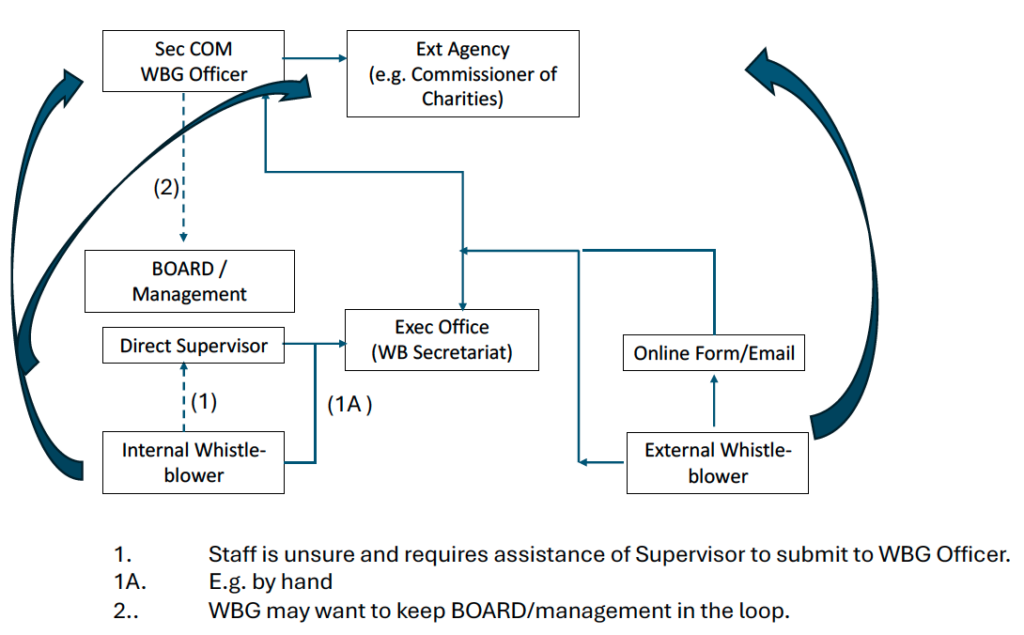
Ways to Raise Concerns for Employees and Other Stakeholders
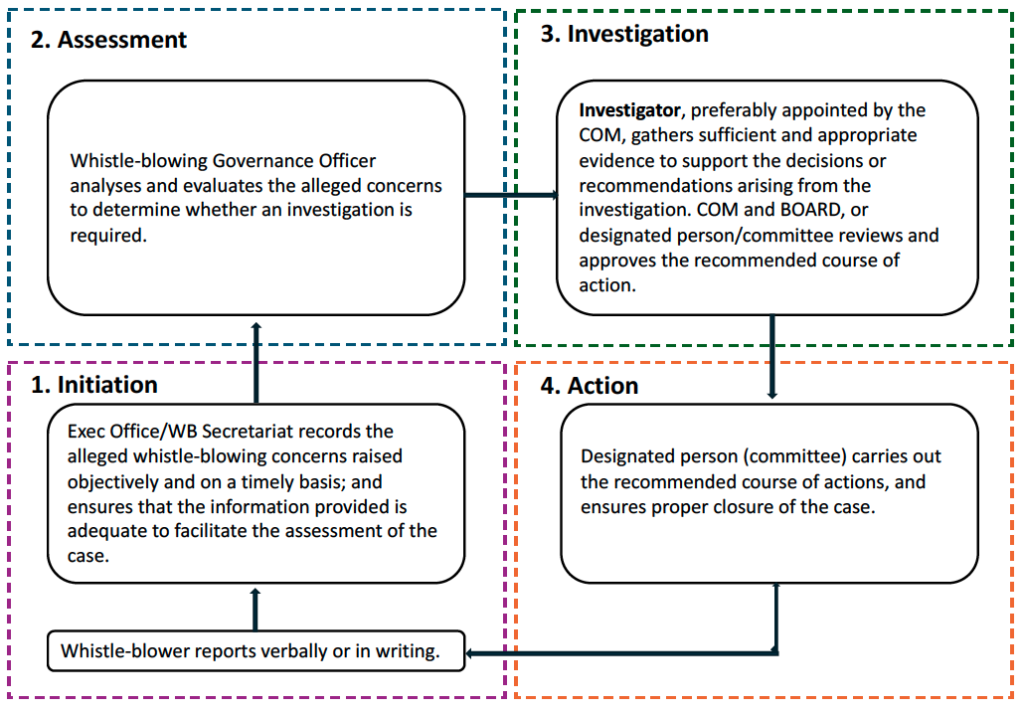
- Initiation (i.e., raising of the concern),
- Assessment of the concern,
- Investigation to substantiate the concern; and
- Measures to ensure that the recommended course of action is carried out, including proper follow-up, notification of the outcome to the whistle-blower for non-anonymous concern raised and closure of the case.
Overview of a Whistle-blowing Process
The ambit of reporting covers whistle-blowing concerns made in good faith either internally or externally. Disciplinary action will be taken against employees for any false report made for personal gain or malicious motive.
The report can be made verbally or in writing using the standard “Form to Report a Whistle-Blowing Concern” below which contains information on what to report. For all reports, including those raised anonymously, SASCO Home will maintain a proper register of all concerns received. It will send an acknowledgement of receipt to the whistle-blower, if the identity is provided, and all reported concerns will be assessed by SASCO Home. The whistle-blower should also be provided with subsequent information on the follow-up processes (e.g., assessment, investigation, and action) as appropriate.
Where the identity of the alleged person is known:
- The escalation of the alleged concern to the Whistle-blowing Governance Officer, or any designated person, e.g., within 24 hours,
- The formal acknowledgement of receipt, e.g., within two weeks,
- Any updates; and
- The closure of the inquiry.
More specifically, (a) and (d) are considered in relation to anonymous alleged concern.
An employee is expected to raise the concerns directly to the Whistle-blowing Governance Officer.
In exceptional circumstances, cases may be raised with the immediate superior to then raise the concern directly to the Whistle-blowing Governance Officer. Cases may be via the Executive Office if the submissions are e.g. by hand. In cases where key management is involved or the concern is exceptionally serious, the whistle-blower can report to the chairman of the COM directly.
The whistle-blower can bypass the internal reporting mechanism and report the concern to the relevant external agency (e.g., Office of the Commissioner of Charities). Safeguards to protect confidentiality must be in place to protect the whistle-blower from reprisal, discrimination, and other adverse consequences.
II. Whistle-blowing process: Assessment
The Whistle-blowing Governance Officer is responsible for the assessment of all the concerns raised, including those which are anonymous in nature. The assessment examines whether the concerns raised are appropriate, i.e., they are not grievances, information provided is adequate to facilitate in the assessment and the nature of concerns, e.g., threats to health and safety, breach of laws, ethical code, and fraud, to establish their severity and implication to SASCO Home.
When the alleged person’s identity is not known, attention should be made in relation to the likelihood of substantiating the allegation from the information provided and any relevant sources.
All assessments and analysis are to be consistent and properly documented, with decisions and outcomes clearly communicated to the appropriate parties on a timely basis.
Inappropriate concerns will not be investigated, and the responsible staff may be subject to disciplinary action. Except for anonymous reports, the whistle-blower may be contacted for clarification or further details on the information provided in the “Form to Report a Whistle-blowing Concern”.
The investigation report will be reviewed by the COM/Board or Audit Committee or a designated committee (e.g., comprising Head of Human Resources, Chief Internal Auditor, and other key personnel). Where appropriate, external advice may be sought to assist in the investigation and review of the investigation report (including the findings and recommendations).
The possible outcomes may include:
- There are no grounds for the concern. Hence, there are no further actions required.
- There are grounds for the concern. Disciplinary action will be taken in accordance with SASCO Home’s disciplinary policies, e.g., reprimand, suspension, and termination of employment. In addition, remedial measures will be taken to minimise recurrence; and
- There may be grounds for a possible criminal offence. COM/BOARD or Audit Committee should be informed, and legal advice may be sought on whether the matter should be referred to the relevant authority for the appropriate action. In all these circumstances, the whistle-blower will be notified of the outcome accordingly.
When the whistle-blower is not satisfied with the outcome of the investigation, he/she can raise the matter with adequate explanation to the Whistle-blowing Governance Officer (or designated staff). If there are reasonable grounds, SASCO Home will examine the concern. The whistle-blower can also raise this concern to a relevant external party.
When the matter must be escalated to an external party, there should be an acknowledgement of the receipt of the referral. The timeline for the implementation of the recommendation should be established to provide an indication on the closure of each case.
There should be a review and follow-up by the Whistle-blowing Governance Officer (or a designated staff) with support provided by the COM/BOARD or Audit Committee to ensure the proper closure of the case.
V. Communications & Training
The whistle-blowing policy is provided to employees by the whistle-blowing Governance Officer, or a designated staff. It is also accessible to all interested parties in SASCO Home’s website.
The whistle-blowing policy is communicated to all staff when they join SASCO Home, and they are briefed on any updates as appropriate. For assistance on whistle-blowing matters, employees should approach the Head of Human Resources, Whistle-blowing Governance Officer, or the designated staff.
SASCO Home supports the training of staff involved in whistle-blowing to stay abreast of developments and to be properly equipped to handle whistle-blowing matters.
VI. Monitor & review
The Whistle-blowing Governance Officer or a designated staff monitors the status of the whistle-blowing process to ensure that it is operating as designed. Some examples include the trend of concerns raised compared to previous years, the number of concerns that failed to meet the established timeline, to record and report to the Whistle-blowing Governance Office, and the number of cases where the investigation progress is behind schedule. The monitored results should be reported to COM/BOARD or the Audit Committee.
Internal audit or an independent party will review the whistle-blowing policy for design effectiveness and will check that the procedures are operationally effective. The review is conducted annually or as directed by COM/BOARD or Audit Committee.
SASCO Home’s Efforts
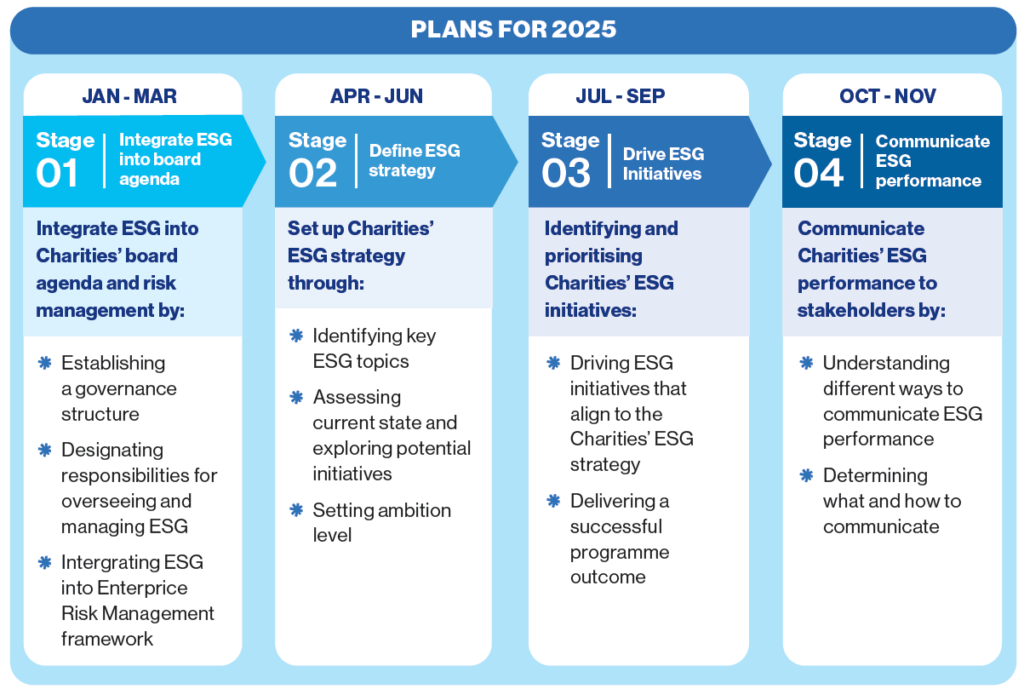
In early 2024, it was included in the Mid-term Plans (MTP 2022-2025), that ESG in Practice would be an initiative. In accordance with the Code of Governance (COG 2023), we formulated a framework and roadmap to implement ESG:
- Formulate and ensure that we pin down the practices, processes and procedures to achieve the desired status.
- Establish a regular monitoring system for these practices, processes and procedures.
Achieved in 2025
An ESG Committee was set up, comprising all the Heads of Departments (HODs) with CEO as the Chairman.
Having established and maintained the basic ESG initiatives, the ESG Committee deliberated and agreed on the following materiality matrix, with some prioritisation:
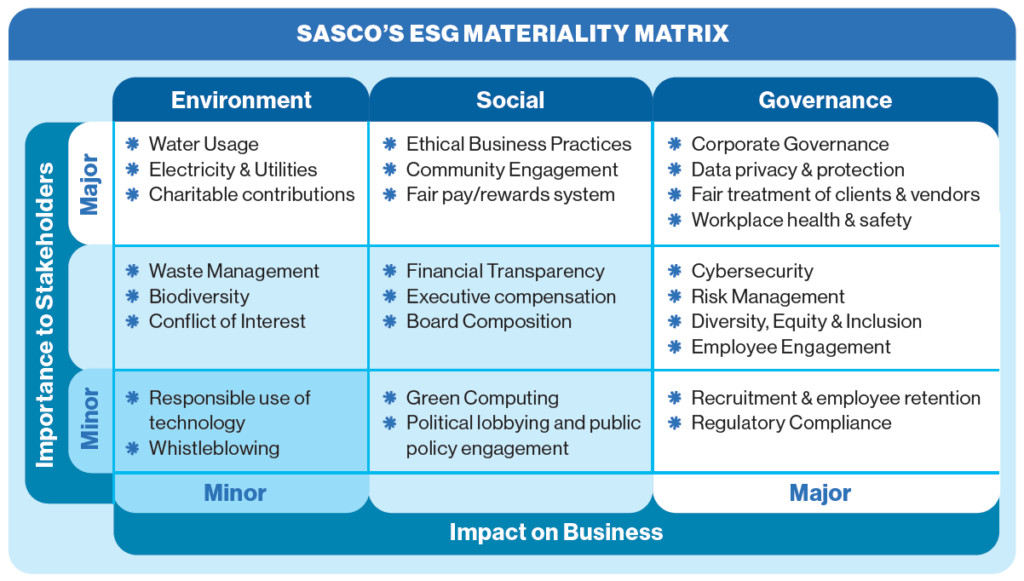
- We embarked on basic tracking of water usage and electricity & utilities savings through the conscious efforts of all concerned at all our facilities.
- We determined that committed volunteers would be the way to go, to ensure effective and efficient community engagement. In 2025 alone, we recruited 604 volunteers (in addition to the 405 volunteers recruited from previous years). We also onboarded 10 volunteer groups comprising 4 education organisations, 4 corporate organisations and 2 government agencies.
Collectively, they contributed 370 intergenerational and festive celebration sessions, totalling 1,026 volunteer hours.
- We attained the Data Protection Trust Mark (DPTM) at the end of 2022 (valid for three years) and continued to maintain/renew our DPTM in December 2025.
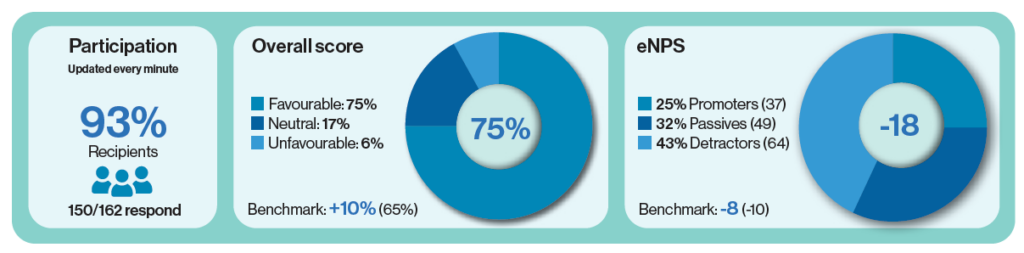
- We participated in the Employee Engagement Social Service (EESS) Survey (by NCSS) in 2022 and then in 2025. We improved markedly in 2025 with:
- A participation rate of 93% (150 of 162 respondents)
- Overall score of 75%
- Employee Net Promoter Score (eNPS) of -18 (or 8 points below the national benchmark of -10)
Plans for 2026
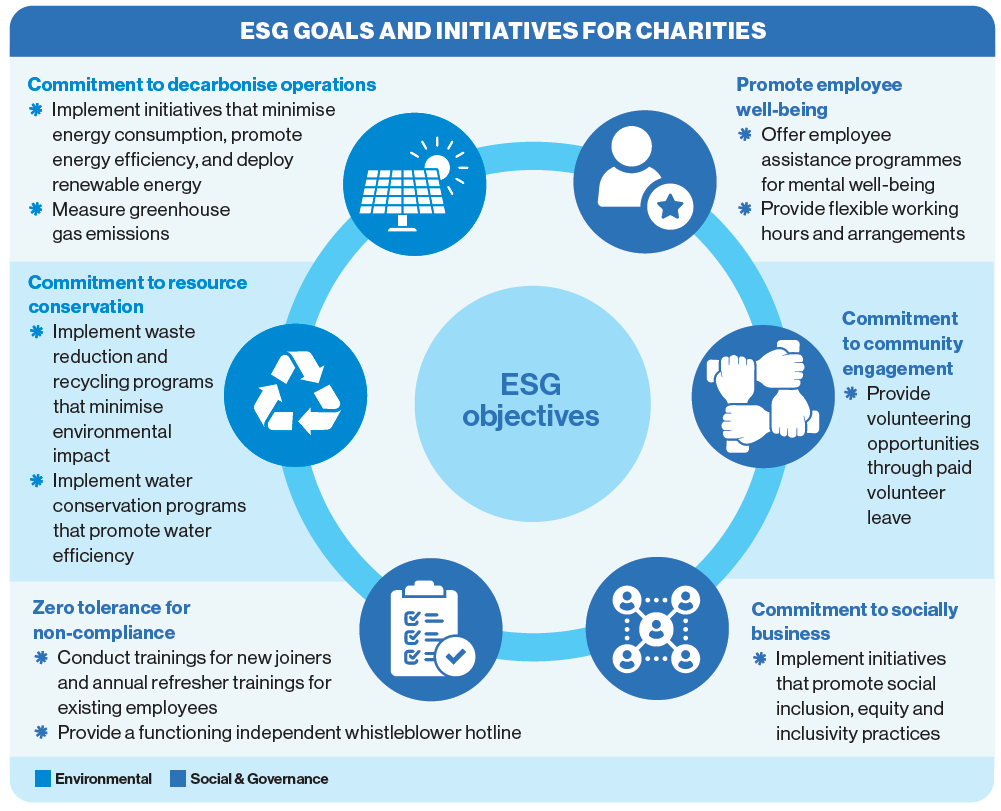
In using the example provided in the ESG Playbook by KPMG (photo below), and referring also to the ESG materiality matrix developed, the plan in 2026 would be to work on ongoing initiatives as well as prioritising new ones:
Priorities
- Continue to implement tracking of water usage and electricity & utilities savings. Additionally, start measuring greenhouse gas emissions via Scope 1, 2 and 3 emissions as relevant to SASCO Home.
- To commit to resource conservation, we would need to determine some form of measurement of wastage.
- In terms of zero tolerance for non-compliance, the HR & Admin Department could implement a more robust onboarding programme for new staff and also a People Development Framework to ensure a competent and reliable workforce.
- To promote employee well-being, HR had included in the policy flexi-work arrangements (for limited periods and subject to supervisors’ approval) and will continue to monitor these arrangements.
- Within SASCO Home, there have been volunteering opportunities. However, going forward, staff who volunteer with SASCO Home’s programmes and activities will receive due recognition accordingly.
- In our commitment to socially responsible business, SASCO Home has, in particular, reviewed the re-employment policy for older workers to age 66 and up to 75 years of age.
Financial Budgeting and Reporting Policy
- Budget preparation
- Approval of budget
- Budget monitoring and reporting
- Preparation of Financial Statements
- CEO – Chief Executive Officer
- CM – Centre Managers
- FN – Finance Department
- HOD – Head of Department
- HCM – Head, Centre Management
Payment Control & Processing Policy
The item description, quantity and price in the supplier’s invoice must match with the purchase/service order and delivery order or service report where applicable. Supplier’s invoice should be processed for payment on a timely basis based on batch processing timeline after the invoice is approved by the HOD.
Staff handling payments are to be separated to the extent possible with regards to:
Monthly statement of accounts received from suppliers should be checked and reconciled with the recorded account payable balances quarterly.
Periodic reviews by management, in comparing expenses incurred with the budget can provide an effective means of
Payments are to be made by cheques, Interbank GIRO, telegraphic transfer, or bank draft. Variations and amendments made should be approved and supported by authorised signatories.
The opening and closing of bank accounts need to be authorised by the board members.
Checks should be conducted to ensure that there are no dormant bank accounts. This is to prevent unauthorised payments, which may be undetected.
Officers for bank signatories should be appointed by Board members. There should be at least two bank signatories for each payment. Bank signatories should be unrelated, if at all possible. The appointed bank signatories with their specimen signatures and their approval limits must be duly endorsed by the banks.
Bank signatories should ensure the following:
Specimen signatures of bank signatories and monthly bank statements issued by the banks should be kept in a secured place. Access to blank cheque books should be limited to Finance Manager and they should be kept in a secured place.
Bank reconciliation should be carried out monthly. Checks are to be made between bank statements and records of receipts and payments in the accounts.
Date, destination, mode of transport, Name and Designation of Person Incurring it, purpose, and amount.
Date, destination, mode of transport, Name and Designation of Person Incurring it, reason for expenditure and amount.
Date, Place of Entertainment, Name and Designation of Person(s) Entertained, purpose, Name and Designation of Person Incurring it and amount.
Procurement Policy
-
Purpose
This policy aims to provide guidance on the procurement practices within SASCO Senior Citizens’ Home (SASCO Home).
-
Definitions
- Quotation – A quotation is a statement of price, terms of sale and description of goods/services provided by vendor to the purchaser.
- Verbal Quotation – A verbal quotation is an unwritten statement of the price, terms of sales and descriptions of the goods/services provided by the vendor to the purchaser.
- Written Quotation – A written quotation is a hardcopy statement of the price, terms of sales and descriptions of the goods/services provided by the vendor to the purchaser received through email, fax or by post.
- Tender – A tender is a definite offer in writing to do certain work or to supply certain goods at a certain sum of money or rate which is provided to a purchaser. The vendor is bound by the contract to fulfil the offer contained in the tender document, failing which will result in a breach of contract.
- Open Tender – An Open Tender is where a tender notice is published in the local newspapers such as “The Straits Times” or any other approved publication inviting any vendor/contractor to bid based on the requirements specified.
- Closed Tender – A Closed or Invited Tender does not require a tender notice to be published. A panel of pre-approved vendors/contractors is invited to tender in writing.
- Procuring Department – the Centre/Department/Unit initiating the procurement.
- Purchase Order (“PO”) – A commercial document and the official offer issued by SASCO Home to a vendor, indicating types, quantities, and agreed prices for products or services. It is used to control the purchasing of products and services from external suppliers. It sets out the terms and conditions of purchases. A standard set of approved SASCO Home terms and conditions will accompany the SASCO Home PO.
- Purchasing System – A new system implemented to replace the hard copy Quotation Evaluation (QE) and Waiver of Competition (WOC) forms to justify purchases from vendors.
-
Principles
The principles governing procurement are:
- Code of Ethics
- Conflict of Interest (including Personal Purchases)
- Segregation of Duties
- Value for Money
- Clarity, Transparency and Fair Competition
1. Code of EthicsEthical business standards shall govern all procurement transactions. All SASCO Home personnel shall not solicit or accept a significant gift from a supplier or prospective supplier.
A ‘significant gift’ is defined as an item, service, favour, monies, credits, or discounts not available to others which could influence purchasing decisions, and also may include the payment of travel costs for SASCO Home personnel to visit a vendor’s location (airfare, hotel, etc.).
Acceptance of social invitations to occasional business meals, entertainment and hospitality will be subject to prudent judgement as to whether the invitation places or appears to place the recipient under any obligation.
If you have any questions about the value of a gift or the appropriateness of an invitation, please refer to your supervisor or Head of Department to ensure compliance with SASCO Home’s conflict of interest policy.
2. Conflict of Interest (including Personal Purchases)A SASCO Home’s purchase order is not allowed for personal purchases. Suppliers are under no obligation to offer discounts to SASCO Home’s employees. If they choose to do so, their offer does not obligate the Charity to do business with them in future.
3. Segregation of DutiesThe procuring department must implement the following segregation of duties:
- The person who creates the PR, PO or performs Goods Receipt (`GR’) will not approve a Purchase Order (‘PO’) in the same acquisition process.
- Staff with access to process payments (Accounts Payable and Treasury) will be restricted from creating PRs and POs.
- Staff will be restricted from creating PRs, POs, and Goods Receipt (‘GR’) in the same acquisition process.
4. Value for MoneyPurchases entered into by SASCO Home shall yield the best possible returns for each dollar spent in terms of quality, timeliness, reliability, after-sales service, upgradeability, price, and source.
5. Clarity, Transparency and Fair CompetitionPurchases entered by SASCO Home at any point in time shall be clear and specific to facilitate better understanding of the requirements and specifications to vendors. Purchasing procedures shall offer equitable access opportunities to all suppliers of goods, services, and construction services. We must demonstrate that the procuring party remains impartial and ensure there is no conflict of interest at all times.
-
Calling for Quotes
To achieve the above objectives, a minimum of three (3) quotations are to be obtained from suppliers for purchases of more than or equal to S$3,000 as follows:
- Price information of three vendors is required for amounts from S$1,000 and to S$3,000 unless waiver of competition is obtained.
- A minimum of three written quotations for amounts from S$3,000 unless waiver of competition is obtained.
-
Invitation and Selection of Quotations
- An invitation to submit a quotation or a quotation issued, or quotation received can be verbal or written depending on the value of the purchases.
- The written quotation shall be received before the deadline specified on the invitation.
- After the closing date, all the quotations received shall be handed to the purchaser who initiated the PO for selection. In general, the lowest quotation shall be selected.
-
Other factors to be considered in the selection of vendor are:-
- Quality of goods/services
- Reliability and Performance of the Vendor
- Ability to supply the goods/services within the required period
- After sales service, if applicable
-
Responsibility of Head of Department / Centre
- Ensure that minimum 3 quotations for purchases amounting to S$3,000 and above are obtained or opt for “Waiver of Competition” (paragraph K below).
- Ensure that for larger purchases, where it is required to call for a tender, the procedures are adhered to, or the relevant approved waiver is obtained.
- Ensure submission date of written quotation falls within the deadline specified in the written invitation for quotations;
- Take the necessary measures to minimize and disallow access by unauthorised persons to all quotations, whether received by hand, email, fax, or post;
- Ensure proper evaluation has been carried out by the Tender Evaluation Committee, award the contract within the validity period of the tender, and ensure that the recommended tenderer is not under any debarment or suspension pending debarment (applicable for tenders).
- Ensure proper evaluation has been carried out by the Tender Evaluation Committee, award the contract within the validity period of the tender, and ensure that the recommended tenderer is not under any debarment or suspension pending debarment (applicable for tenders).
- Ensure a PO is raised for all purchases except for those with amounts of less than S$300 per transaction and those which are based on usage charge. Approval of PO is as per Annex A – Approval Authority Guide. Such an approval represents the approval of the purchases. No separate authorisation on the hard copy invoice is required.
- Ensure that purchases without a PO still go through proper approval with proper evidence on the hard copy invoices and/or any other purchase agreements or documents. Such approval must follow the approved limits as per Annex A – Approval Authority Guide.
- Discourage staff from making purchases of S$1,000 and above directly from vendors and seeking subsequent reimbursement as this will bypass the proper procurement process which includes ensuring proper commitment of funds against budget.
- Take note that IT Department is the recommended point of contact for placing orders for IT Assets, such as hardware and software on behalf of the organisation, except for IT peripherals or personal productivity tools.
- Ensure that there is a sufficient budget for all purchases.
- Ensure acknowledgement of physical goods received is being carried out and timely completion of goods receipt function in the Purchasing System. Performing goods receipt function in system records accruals for expenses incurred but not yet paid.
- Ensure that all redundant unfulfilled POs are cancelled timely. This can prevent any unauthorized purchases from being receipted using such open POs, resulting in unauthorized payment.
-
Availability of Budget
- Each Head of Department / Centre is accountable for managing his/her department’s budget. When the purchaser raises a PR in the Purchasing System, they will be required to check the availability of budget for the expenditure to be incurred.
- In cases where there is insufficient budget, HOD will be required to seek approval for additional budget. They will have to ascertain from the Office of Finance whether a virement can be obtained.
-
Approval Authority Guide
- The Chairman, as authorised by the Board, will be the approving authority to authorise delegation of approval limits for procurement of goods and services and payment of expenditures.
- The approval limits are delegated to the appointed officers based on their specific designation example the Heads of Departments/Centres/Units.
See Annex A for a detailed guide of the approval authority and limits.
-
Less Than S$3,000 Purchases
- For purchases that are less than S$3,000, three quotations are not required. However, the guiding principles for procurement, i.e. Codes of Ethics, Conflict of Interest, Segregation of Duties, Value for Money, and Clarity, Transparency and Fair Competition shall still apply.
- The Individual Department is to source for required vendors directly. The selection and appointment of vendor(s) shall be approved by the Head of Department / Head of Centre or Unit.
- The Procuring Department is encouraged to procure from the approved list of vendors.
- Please refer to Paragraph M below.
-
Purchases Requiring Tenders
-
Open Tender
- All intended procurement of S$100,000 and above requires an Open Tender.
- A minimum of 3 written quotations is required.
-
Closed Tender
- If the Procuring Department wishes to opt for a Closed Tender, it shall apply to the relevant authority for approval based on Annex A – Approval Authority Guide.
- Closed Tenders requires a minimum of 3 written invitations.
-
Electronic Submission of Tenders (Future proofing)
Electronic submission of tender bids (E-Tender) should only be permissible under exceptional cases such as where there is no local presence AND the Tender documents are expected to be bulky. Approval shall be sought from the relevant authority based on the Annex A – Approval Authority Guide.
-
Security Deposit
A security deposit amounting to 5% of the tendered sum (in the form of a Banker’s Guarantee) is collected for accepted tenders with a value of $500,000 or more. This is to ensure that any financial loss from the risk of non-performance from the awarded tenderers is adequately secured.
Where tenders are called which do not have an upfront fixed committed sum, such a security deposit can be waived. Such tenders will include tenders called to appoint a panel of pre-approved vendors or recommended vendors where the organisation does not commit upfront any lump sum business. For the latter tenders, the billings and subsequent payments will only be effected upon the satisfactory delivery of the requisite goods and services. (Refer to Section M for examples of goods and services provided by approved and recommended vendors.)
-
Open Tender
-
Waiver of Competition
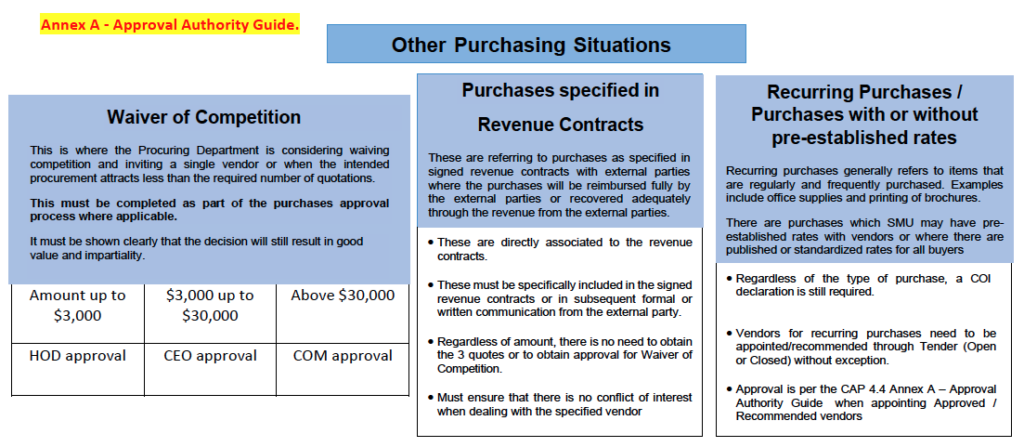
- In a situation where the intended procurement is more than or equal to S$3,000 and the Procuring Department wishes to opt for “Waiver of Competition”, or where the intended procurement attracts less than the required number of quotations, it is required to apply to the following authorities for a Waiver of Competition to award to the preferred vendor which will be carried out via the Purchasing System. It must be shown clearly that in a waiver of competition circumstance, the decision will still result in good value and impartiality by SASCO Home.
-
Up to S$3,000
Waiver of Competition can be approved by Head of Department / Centres / Institutes of Procuring Department. -
All amounts up to S$30,000
Waiver of Competition will be approved by CEO. -
All amounts up to S$200,000
Waiver of Competition will be approved by Finance Sub-Committee. -
All amounts more than S$500,000
Waiver of Competition will be approved by Committee of Management.
-
Purchases Specified in Revenue Contracts
- These are referring to purchases as specified in signed revenue contracts with external parties where the purchases will be reimbursed fully by the external parties or recovered adequately through the revenue from the external parties.
- These generally relate to conference venues and eating places and are pre-selected by the external parties and included as part of their written requirement to be fulfilled in the revenue contracts. The purchases may also extend to hotel accommodation, training materials, team building trainers and industry visits.
- For such purchases, where they are directly associated to the revenue contracts and are specifically included in the signed revenue contracts or in subsequent formal or written communication from the external parties, it is not necessary to obtain the 3 quotes or to obtain approval for Waiver of Competition. However, it is necessary to ensure there is no conflict of interest when dealing with the specified vendors and/or to make the proper declaration as required under the SASCO Home’s Code of Conduct.
-
Recurring Purchases
-
Recurring purchases refer to those that are procured on a regular and frequent basis and can be generally classified into 2 categories: Generic Items and Non-Generic Items purchases.
- Generic items purchases refer to procurement of generic homogeneous products/services that can be widely supplied by a large group of Approved Vendors. Such items include general office supplies, office computers and laptops, small office equipment, printing, photography, travel, postage, and courier services; and
- Non-Generic items purchases refer to procurement of non-generic or an assortment of products/services which are difficult to procure from a particular vendor which offers the lowest quote for the full range of products/services. A list of Recommended Vendors has been appointed to provide such services. Examples of such services include general logistics and maintenance services and specialised services such as legal and financial services, specialized IT equipment.
-
The offices which are in charge of initiating the appointment of Approved and Recommended vendors are tabulated below.
Types of Goods/Services Departments/Units in charge Generic General Office Supplies CAA Computers/IT IT Printing, Photography, etc CAA Travel CAA Postage & Courier FIN Non-Generic Logistics & Maintenance CAA Specialised services Respective units/depts Specialised IT Equipment IT The list of Approved and Recommended Vendors are appointed through competitive bidding by tender on a regular basis. Departments/Centres must procure the generic products/services from Approved Vendors unless the items are not available from these vendors. For recurring purchases of non-generic items, Departments/Centres can use them as reference to facilitate such purchases.
- Approval to award Approved or Recommended vendors shall be obtained from the relevant authority based on Annex A – Approval Authority Guide.
-
The number of Approved/Recommended Vendors for recurring purchases shall be capped at not more than 15 for each type of goods/service to be procured. Or:
- if there was an agreement with the vendor for a consignment of a predetermined number, usually specified in the ITQ;
- if there was an agreement for a minimum number of purchases for the year but on a consignment basis.
- Orders placed with these Approved/Recommended Vendors need not go through the required quotation or Waiver of Competition approval process.
-
Recurring purchases refer to those that are procured on a regular and frequent basis and can be generally classified into 2 categories: Generic Items and Non-Generic Items purchases.
-
Purchases of Goods and Services with Pre-Established Rates
- For purchases of goods and services where pre-established rates for the goods and services have been established with SASCO Home, it is not necessary to obtain 3 quotes or to obtain approval for Waiver of Competition (WOC). Pre-established rates can be in the form of a signed agreement. Likewise, when purchases are made from sole suppliers with published rates, justification for such purchases via WOC will not be required.
- For purchases of goods and services without pre-established rates with SASCO Home, the Procuring Department will have to put up for WOC. However, where payment is required to professional associations / bodies, accreditation associations / institutions, attending training / conferences and the applicable rates are published and standardised for all subscribing organisations and individuals, the Procuring Department will not be required to put up WOC.
- For purchases of goods and services which are in line with HR’s policy, or with exceptions which are approved by Head, HR, relating to Learning and Development, specifically in-house training, external training, team building and team retreat, the Procuring Department will not be required to put up Waiver of Competition.
- To ensure full compliance with procurement policies, a declaration that there is no conflict of interest (COI) is still required for all purchases. At all times, the HOD / HOC of procuring departments must ensure there is good value to SASCO Home.
-
Summary for Conflict of Interest (COI) Declaration and Waiver of Competition Requirements (For Amounts > S$3,000)
- A summary for the COI Declaration and WOC requirements can be found in the following table:
| Amount | Approver |
|---|---|
| Up to S$3,000.00 | HODs / CMs |
| >S$3,000.00 up to S$30,000.00 | CEO |
| Above S$30,000.00 | Evaluation Committee |
| Above S$100,000.00 | Committee of Management |
- All S$1,000.00 and above POs shall be approved by CEO (in the system).
- All POs below S$1,000.00 shall be approved by HOD
- For urgent purchases where the POs are issued after the purchase/work done and hence the invoice issued, the respective HODs should have been informed and justifications given to CEO accordingly.
-
Processing of Payment Vouchers:
- The payment vouchers with the approved invoices must be submitted for approval by the authoriser.
- Invoice computations and pricing should be verified before payment approval.
- Upon obtaining approval from the authorised signatory, the processed payment vouchers and supporting documents must be stamped “PAID”, with particulars of dates and payment mode, to prevent their re-submission for duplicate payment.
-
Segregation of Duties:
Staff handling payments are to be separated to the extent possible with regards to:
- Initiation of purchase requisition,
- Approval of vouchers and invoices, and
- Signing of cheques, authorise online e-payments.
-
Reconciliation of Accounts:
Monthly statement of accounts received from suppliers should be checked and reconciled with the recorded account payable balances quarterly.
-
Review of Expenditures:
Periodic reviews by management, in comparing expenses incurred with the budget, can provide an effective means of
- controlling expenses,
- detecting errors and deviations from rules and policies.
-
Proper Authorisation:
Payments are to be made by cheques, Interbank GIRO, telegraphic transfer, or bank draft. Variations and amendments made should be approved and supported by authorised signatories.
-
Bank Accounts
- The effective controls in management of bank accounts aims to prevent fraudulent practices that include unauthorised payments.
-
Proper Authorisation:
The opening and closing of bank accounts have to be authorised by the board members.
-
Dormant Bank Account:
Checks should be conducted to ensure that there are no dormant bank accounts. The aim is to prevent unauthorised payments, which may be undetected.
-
Bank Signatories:
The board members must appoint responsible officers as bank signatories. There should be at least two bank signatories for each payment. Bank signatories should be unrelated, if at all possible. The appointed bank signatories with their specimen signatures and their approval limits must be duly endorsed by the banks.
-
Authorising Payments:
Bank signatories should ensure the following:
- Payments are accompanied by properly approved suppliers’ invoices and payment vouchers.
- Payee’s name and amount agree with the details on the invoice.
- Payments to be authorised must not be made payable to themselves.
- Cheques issued without payee’s name should not be signed.
- Cash cheques should be limited only to the top-up of petty cash float.
-
Physical Security:
Specimen signatures of bank signatories and monthly bank statements issued by the banks should be kept in a secured place. Access to blank cheque books should be limited to Finance Manager and they should be kept in a secured place.
-
Bank Reconciliation:
Bank reconciliation has to be carried out monthly. Checks are to be made between bank statements and records of receipts and payments in the accounts.
-
Employee Expense Reimbursement
- This policy shall apply to all our employees that need to spend money for work-related activities. Mileage and transport reimbursement claims will be in accordance with HR policy.
- Reimbursements will be made for all approved business expenses. ‘Business expenses’ are expenses related to our organisation operations. Employees must be able to show why they need to incur the expenditure in the course of duty.
- Expenses that are personal and private in nature are not allowable as they do not relate to our operations.
-
Staff reimbursement/Expenses claim approval process:
- Original copy of receipts or invoice must be submitted.
- Claims receipts more than 3 months will be subjected to CEO/HCM approval.
- Claimants must have obtained approval from their respective HODs.
- Reimbursements will be made through GIRO.
-
Purchases >$300 will be paid directly to vendors. In exception circumstances, employee may be allowed to pay for purchases on behalf of the Home but will require approval.Centre ManagementAmount up to $300.00 – approved by HOD/CMAmount > $300.01 to $500.00 – approved by HCMAmount > $500.01 to $1,000.00 – approved by CEOHQAmount up to $300.00 – approved by HODAmount > $300.01 to $1,000.00 – approved by CEO
- Claiming of expenses on behalf of others are not allowed.
-
Information / Business purposes to be included in the claims. Finance’s role in checking employees expense claims would be to check if the expense is business related, comply with organisation policies and if there is approval from HOD.
- Transport – date, destination, mode of transport, Name and Designation of Person Incurring it, purpose, and amount.
- Travelling – date, destination, mode of transport, Name and Designation of Person Incurring it, reason for expenditure and amount.
- Entertainment – date, Place of Entertainment, Name and Designation of Person(s) Entertained, purpose, Name and Designation of Person Incurring it and amount.
Committee of Management Self-Evaluation Checklist
Introduction
This self-evaluation checklist describes relevant areas of the Board’s responsibilities (although non-exhaustive), with the aim also, of capturing an objective self-evaluation (checklist) to help guide the Committee of Management (COM) in a progressive mindset.
Checklist
In your assessment, indicate whether the COM currently does a satisfactory job in an area or whether improvements to its performance are required, based on a 5-point Likert scale. Please circle the number (from 1 to 5) immediately after the questionnaire statement.
Ad hoc
basis
provisions
with sufficient
details
and organised
Is there a clear and proper communication channel in the structure?
Are the roles of the members clearly defined and understood?
Is the Secretariat Office fulfilling the Home’s needs and tasks adequately?
Is the Secretariat Office effective and efficient?}
Are the policies clearly understood by the respective members and staff?
Are there clearly defined plans for the organisation?}
with major
improvements
needed
improvements
needed
refinements
needed
Qualitative Evaluation
(Other comments or further views/reflections that may not have been addressed by the items listed above. Can also include recommendations or suggestions.)
NB. Please type your responses/inputs.
16)
This checklist is used to self-assess the performance of SASCO Home’s COM over the past financial year period, on the following areas:
- Vision & Mission
- Strategic Planning
- Monitoring and Evaluation
- Financial Controls
- Board Health
| Board Members | Vision & Mission | Strategic Planning | Monitoring & Evaluation | Financial Control | Board Health |
|---|---|---|---|---|---|
| Mr Farihullah | 5 | 4.67 | 4.5 | 5 | 5 |
| Mr Bernard Tan Leng Joo | 5 | 5 | 4.75 | 5 | 5 |
| Mr Iskander | 5 | 5 | 4 | 4.5 | 4.5 |
| Mr John Raghavan | 5 | 4.83 | 4.5 | 4.5 | 4.5 |
| Mr Subramaniam | 5 | 5 | 5 | 5 | 5 |
| Mr Jignesh | 4 | 5 | 5 | 5 | 5 |
| Mr Lakhbir Gill | 5 | 5 | 4.5 | 5 | 4.5 |
| Mr Daryl Han Keen Siew | 5 | 4.83 | 5 | 4.5 | 4 |
| Dr Hirman Khamis | 4 | 4.67 | 5 | 4.5 | 5 |
| Mr Ng Kim Seng, Paul | 4 | 4.5 | 4.5 | 5 | 5 |
| Mr Pasupathy M. | 4 | 5 | 4.75 | 5 | 5 |
By-Laws
In this By-laws, unless the context otherwise required:
The objects of the Home shall be as follows:
In furtherance of the above objects, but not otherwise, and provided that nothing is done for commercial reasons or solely for profit, the Home may exercise the following powers:–
Members of the Board shall be appointed by the Committee of Management (COM) of SASCO Limited, provided that more than half of the Board members must be independent of SASCO Limited. A committee member is “Independent” if he is:
The proposer and seconder must be members of the Board or Affiliate Members of the SASCO Ltd. The completed form must be submitted to the Home. The Board shall elect from among themselves the following key positions:
And may also elect if they see fit, a vice-chairman, assistant secretary and assistant treasurer.
The Board shall meet as often as it deems necessary but not less than 6 times each year and at least five (5) Board members shall be required to constitute a quorum at such meetings. Seven clear days’ notice of such meetings shall be given to each member of the Board.
The Secretary shall:-
The Treasurer shall:
If necessary, the SASCO Limited COM may, after obtaining the necessary approval from the necessary approval from the relevant authorities, organise fund-raising activities to solicit for donations or otherwise in aid of the SASCO Senior Citizens’ Home Fund.
The funds of the Home shall consist of:-
The signing mandate for payments via cheque or online banking platform shall be (Chairman, Treasurer, Secretary and CEO as authorised signatories):
Approved for Submission: Chairman, Farihullah s/o A W Safiullah
Date: 12 September 2023
Approved by Commissioner of Charities in 2023