Relationship
As a programme under SASCO Limited, SASCO Home is not a separate legal entity from SASCO Limited. But SASCO Home has to be a separate entity – with its own UEN number, by-laws, BOARD of Directors, and separate statutory audit of its finances – in order for SASCO Home to be a charity with IPC status.
Our parent body appoints the Members of the BOARD of Directors (“BOARD”) of SASCO Home, with 49% representation from the Committee of Management (COM) of SASCO Limited and 51% being Independent Members. The structure of the BOARD is in compliance with the Charity Act and the by-laws of the Home.
BOARD Members are encouraged to attend training programmes, seminars and workshops organised by professional institutions to keep apprised of relevant laws, regulations and changes in the social service landscape. The BOARD meets on a monthly basis, keeping pace with management and the rigorous developments of the organisation.
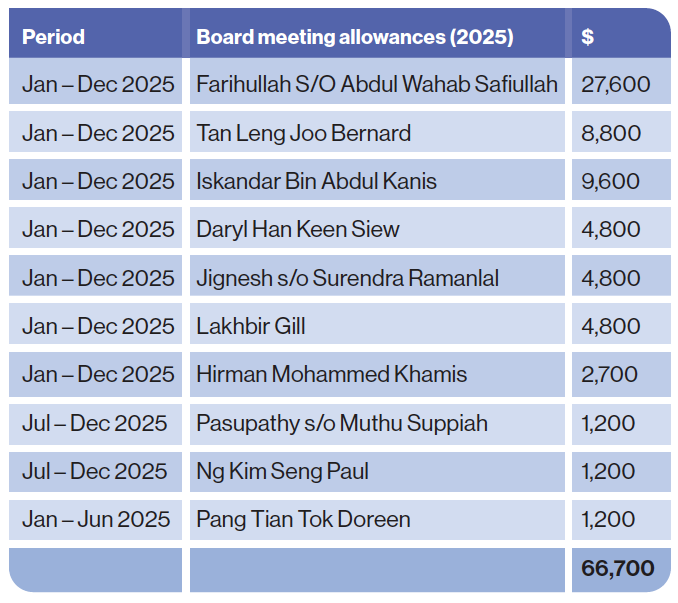
BOARD Members of SASCO Home serve as volunteers and do not receive any monies from SASCO Home, but are reimbursed with monthly allowances, as with sub-committees of SASCO Limited. SASCO Limited sees the BOARD members of SASCO Home as ‘another of its sub-committees’ and hence, with approval from its constituents (affiliate members at the AGM), provides a monthly allowance to the Independent BOARD members:
SASCO Limited’s key Committee of Management (COM) members, Mr John Raghavan (Vice-Chairman) and Mr Subramaniam Krishnan (Secretary), represented SASCO Limited on SASCO Home’s BOARD.
The BOARD Members renewed their tenure in July 2025 for another year, in accordance with the renewal process in our By-Laws and that of our parent body, SASCO Limited’s Constitution. For the new term of tenure, we have 11 Board members altogether.
Audit Committee
The Audit Committee (AC) for 2025 comprised Mr Bernard Tan Leng Joo (Head of Committee), Mr Subramaniam s/o Krishnan, and Ms Cath Mong (Independent Member). The AC assists the BOARD in fulfilling its oversight and fiduciary responsibilities to act in the interest of SASCO Home, the scope and responsibilities of which include:
- Reviewing and evaluating the effectiveness and adequacy of internal control systems to ensure the integrity and confidentiality of critical information;
- Ensuring the adequacy of disclosure of any public financial reporting;
- Reviewing the effectiveness of internal control to mitigate operational, financial and business risks;
- Reviewing the robustness of the corporate governance structure;
- Reviewing the internal and external audit plans and reports.
Internal Audit (IA)
For 2025, the AC determined a plan for the next three years – to conduct an internal audit into the areas reviewed by the MSF Governance Review in 2021. The review by Ernst & Young then provided 75 findings and recommendations, which were fully fulfilled by the end of 2021.
Nevertheless, the AC contended that the internal audits, in yearly phases, could look into:
- 2023 – Compliance areas (14 findings)
- 2024 – Governance areas (23 findings)
- 2025 – Internal Controls and Processes (37 findings)
The 2025 IA concluded successfully without any ‘non-compliance’ findings.
Annual Remuneration Disclosure
In accordance with the Code of Governance for Charities and Institutions of Public Character 2025, the remuneration of SASCO Home’s three highest-paid staff, is as follows:
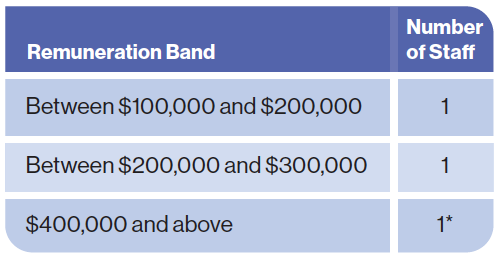
Staff remuneration is subject to remuneration guidelines approved by the BOARD and sector salary guidelines.
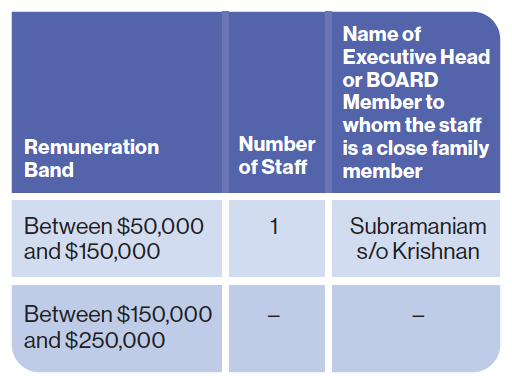
SASCO Home has one paid staff member who is related to a BOARD Member and who received more than $50,000 during the year 2025.
Conflict of Interest Policy
In accordance with the Code of Governance 2023, as members of the charity sector, we have an obligation to act in the best interests of SASCO Senior Citizens’ Home (the Charity) and the public. We have had a ‘Conflict of Interest’ policy in place since 2021 to avoid situations where there may be real, potential or perceived conflicts of interest, which may arise when a member’s personal or family interests are in conflict with those of the Charity.
This policy aims to protect both the Charity and its members from any appearance of impropriety, which may result in:
- damaging the Charity’s reputation;
- influencing the member’s judgement and compromising objectivity when conducting the Charity’s affairs;
- restricting free discussion, thus resulting in decisions or actions that are not in the interest of the Charity; and risking the impression that the Charity has acted inappropriately or unfairly.
Investment Policy & Reserves Policy
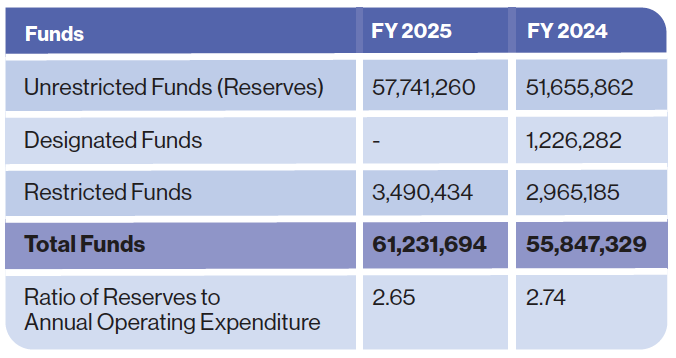
These policies govern the Charity’s financial and accounting activities to ensure compliance and accountability in the usage of charitable funds received through donations and grants.
By-Laws
The governing instrument for the Charity is its by-laws, last amended on 16 October 2013, has since been approved in October 2023, by MSF.
Charity Act
SASCO Senior Citizens’ Home is registered under the Charity Act.
UEN: S89CC0702G
GST Registration No: M90368299G
It is an Approved Institution of a Public Character (IPC), and affiliated to the National Council of Social Service (NCSS).
Whistle-blowing Policy
SASCO Home is committed to lawful and ethical behaviour in all its activities and requires that its BOARD Members, Management, staff, volunteers and consultants conduct themselves in a manner that complies with all applicable laws and internal policies.
In keeping with this commitment and SASCO Home’s interest in promoting open communication, its whistle-blowing policy aims to provide a means through which concerned employees can raise ethical and governance-related issues with the assurance that their identity will be kept confidential and that they will be protected from reprisals or victimisation for acting in good faith.